





























What are some common clinical waste examples?

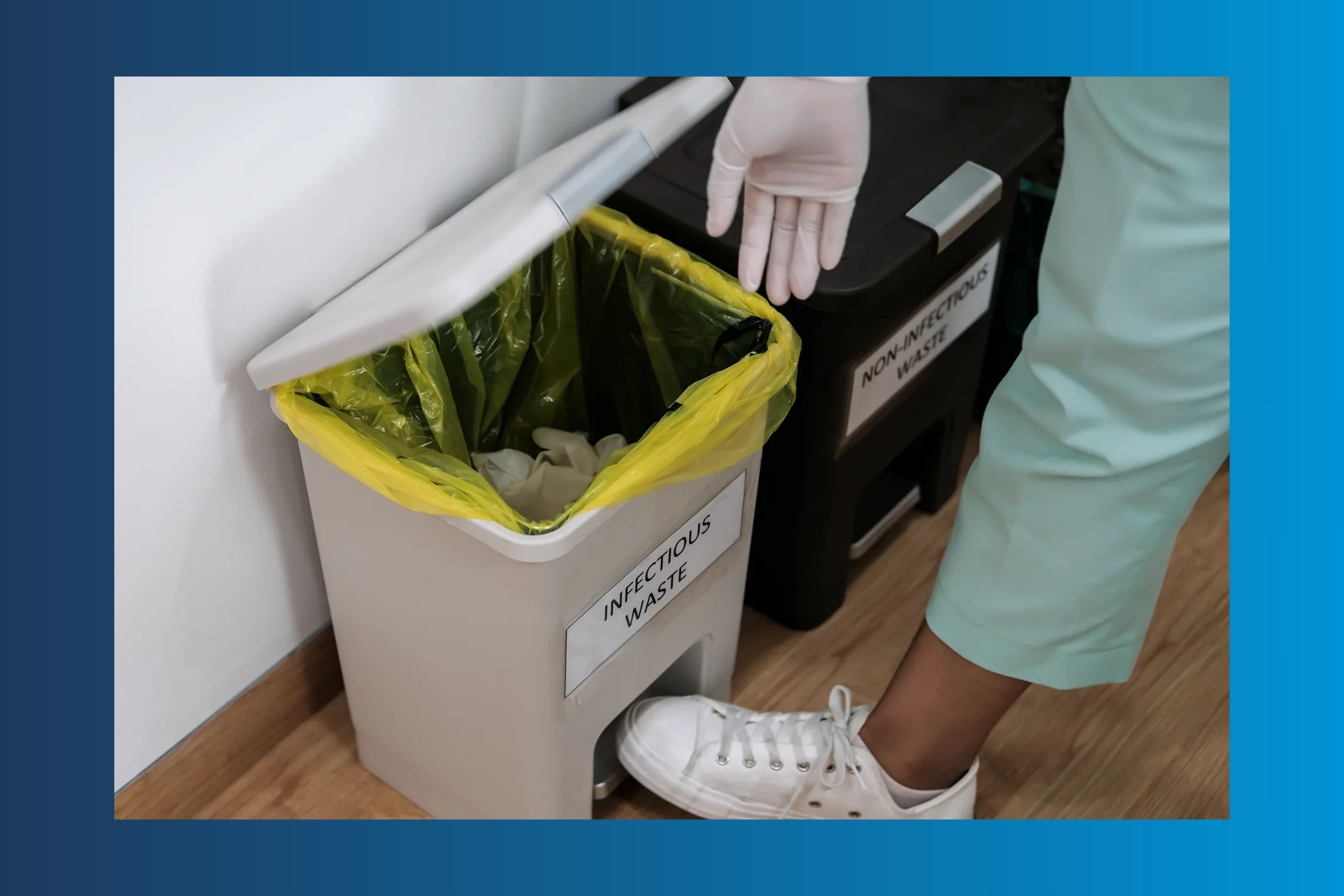
There are lots of types of clinical waste, such as sharps, infectious and biomedical waste. Sharps might include needles, syringes and scalpels, while infectious waste could include contaminated dressings, disposable gowns and contaminated bed roll.
What are the CQC requirements for clinical waste management in the UK?
The Care Quality Commission (CQC) requires registered healthcare providers to manage clinical waste safely as part of their fundamental standards. This is specifically laid out in Regulation 12 (Safe Care and Treatment) and Regulation 15 (Premises and Equipment).
In practice, this means that healthcare providers must have a written policy in place for clinical waste management. They must also ensure that staff are trained in proper waste segregation, and that they use colour-coded, labelled containers. In addition, the CQC outlines that healthcare settings must work with a licensed waste carrier, and that any documentation, like waste transfer notes, is maintained and kept up to date.
How do I segregate clinical waste ready for collection?
Clinical waste in the UK has to be segregated at the point of production using a colour-coded system set out in the Health Technical Memorandum 07-01. The system is as follows:
- Yellow containers – infectious waste for incineration
- Black and yellow stripes (tiger bags) – offensive waste that is non-infectious
- Orange bags/containers – infectious waste that can go to alternative treatment
- Blue containers – pharmaceutical waste
- Purple containers – cytotoxic and cytostatic medicines
- Red containers – infectious and non-infectious anatomical waste for incineration
Sharps must always go into a rigid sharps bin that’s the correct colour for the specific type of sharps:
- Yellow lid – sharps contaminated with blood and medicines
- Orange lid – sharps contaminated only with blood
- Purple lid – needles used for cytotoxic and cytostatic medicines
How long can clinical waste be stored before it needs to be removed?
Clinical waste has to be removed within a set time, as laid out by the Environmental Permitting Regulations. As a general rule:
- Infectious waste and refrigerated anatomical waste can be stored for up to 14 days
- Unrefrigerated anatomical waste can be stored for up to 24 hours, or 72 hours if over a weekend
- Offensive waste types can be stored for up to seven days outside, or up to 14 days inside a building
These medical waste removal timeframes might change for very large premises or settings that operate under an environmental permit.
For hygiene reasons, it’s best to have your medical waste removed before these limits, arranging a set removal schedule that means waste can be regularly collected before containers start to overflow.
Do I have to label the clinical waste that will be removed? How do I do this?
Yes, labelling is a legal requirement under the Hazardous Waste Regulations 2005 and the Carriage of Dangerous Goods regulations. The label should include the name and address of the premises, a description of the waste and its UN classification, and hazard symbols if required.
You’ll also need to complete a waste transfer note (or a consignment note for hazardous waste) each time clinical waste is collected. This will form part of your legal audit trail.
What happens to the clinical waste you remove?
We handle each type of clinical waste accordingly, recycling what we can or diverting it to energy-from-waste partners. We also try to use environmentally friendly healthcare waste disposal methods where possible. However, some waste needs to be incinerated, such as anatomical waste and cytotoxic materials.